
TL;DR: Digital transformation expands your attack surface before it expands your capabilities. IBM’s 2024 Cost of a Data Breach report puts the average breach at $4.88 million globally, and SMEs are disproportionately targeted because they’re assumed to have weaker defenses. This guide covers the threat landscape specific to digitizing businesses, a practical five-layer security model, the security risks unique to cloud migration and AI adoption, and a compliance checklist you can act on without a dedicated security team.
Introduction
Every digital transformation conversation eventually gets to the same uncomfortable question: “if we move everything online, aren’t we just creating more ways to get hacked?”
The honest answer is yes — and no. Digitizing manual processes, moving to the cloud, and adopting AI tools does expand your attack surface. But the businesses that get breached are rarely the ones that digitized carefully; they’re the ones that digitized without building security in from the start, then bolted it on after an incident forced the issue.
IBM’s 2024 Cost of a Data Breach Report found the global average cost of a data breach reached $4.88 million, a 10% increase year-over-year (IBM Security, 2024). Verizon’s 2024 Data Breach Investigations Report found that 43% of breaches involved small and medium-sized businesses — not because SMEs are bigger targets, but because attackers know smaller organizations are more likely to be under-defended (Verizon DBIR, 2024).
This guide is written specifically for organizations in the middle of digital transformation — moving to the cloud, adopting AI tools, integrating systems — where security needs to be part of the plan, not an afterthought.
The Threat Landscape Specific to Digital Transformation
General cybersecurity advice (“use strong passwords, patch your systems”) is necessary but insufficient for organizations actively changing their technology stack. Transformation projects introduce specific, predictable risk windows.
| Transformation Activity | Specific Risk | Why It Happens |
|---|---|---|
| Cloud migration | Misconfigured storage buckets exposed publicly | Default settings not reviewed before go-live |
| System integration | Overprivileged API credentials | Broad access granted for convenience during build phase, never scoped down |
| AI tool adoption | Sensitive data sent to third-party AI models | Employees pasting confidential data into public AI chat tools without policy or awareness |
| Legacy system retirement | Old system left running with stale credentials | Decommissioning treated as “turn it off later,” never fully executed |
| Remote/hybrid work rollout | Weak endpoint security on personal devices | BYOD policies adopted without corresponding device management |
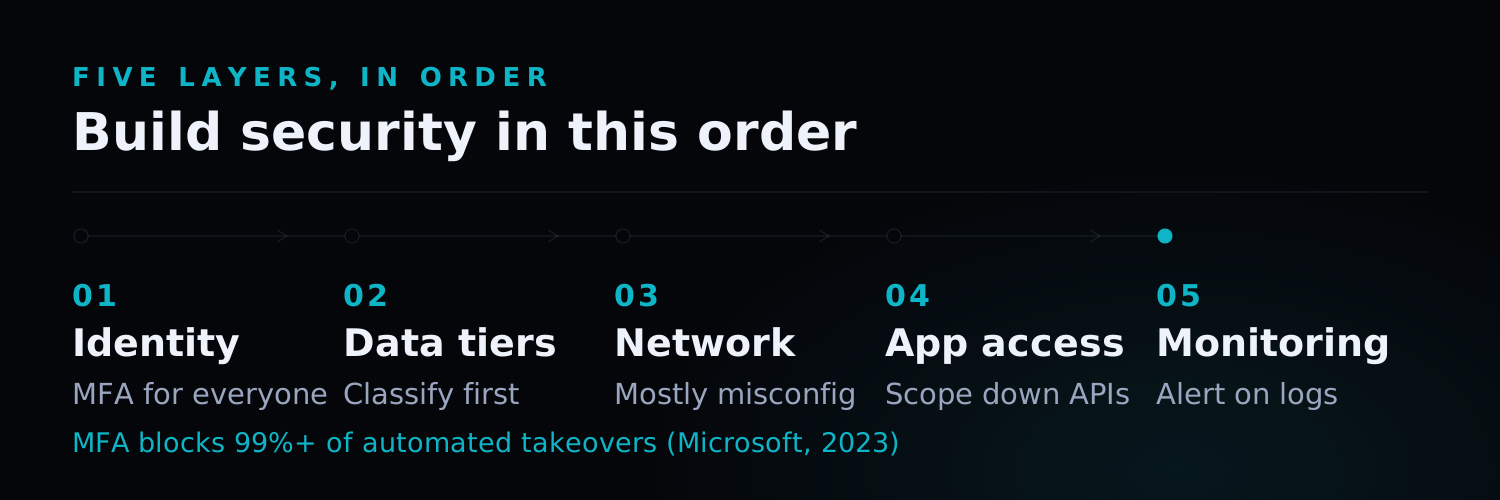
A Practical Five-Layer Security Model
Rather than a checklist of individual tools, think of security as five layers that each need attention — this is the model we use when assessing a client’s security posture during a digital transformation engagement.
Layer 1: Identity and Access Management
The single highest-leverage security investment for most SMEs. Multi-factor authentication (MFA) alone blocks over 99% of automated account-compromise attacks, according to Microsoft’s own security telemetry (Microsoft Security, 2023).
- Enforce MFA on every account with access to business systems, not just admin accounts
- Apply the principle of least privilege — every account gets the minimum access needed, reviewed quarterly
- Use single sign-on (SSO) where possible so access can be revoked instantly across systems when someone leaves
Layer 2: Data Classification and Encryption
You cannot protect what you haven’t identified. Classify data into tiers (public, internal, confidential, regulated) before deciding where it can live and who can access it.
- Encrypt data at rest and in transit as a default, not an exception
- Identify which data is regulated (PII, payment data, health records) and map exactly where it flows across your integrated systems
- Apply data loss prevention (DLP) tooling on channels where regulated data could leave the organization (email, file sharing, AI chat tools)
Layer 3: Network and Infrastructure Security
As systems move to the cloud, the network perimeter stops being a physical firewall and becomes a set of configuration decisions.
- Review cloud storage and database access settings explicitly — misconfiguration, not sophisticated attacks, causes the majority of cloud data exposures
- Segment networks so a compromise in one system (e.g., a marketing tool) can’t reach core business systems (ERP, financial data)
- Keep infrastructure patched on a schedule, not reactively
Layer 4: Application and Integration Security
Every API integration and every AI tool connected to your systems is a potential entry point.
- Scope API credentials to the minimum permissions the integration actually needs (see our API integration guide for the reliability side of this)
- Review third-party AI tools’ data handling policies before connecting them to business data — many consumer AI tools retain input data for model training by default
- Run security testing on custom-built applications before go-live, not just functional testing
Layer 5: Monitoring, Response, and People
Technology controls fail eventually. The organizations that recover quickly from incidents are the ones with monitoring and a plan, not the ones who assumed prevention would be perfect.
- Set up centralized logging and alerting so unusual access patterns are flagged, not discovered weeks later
- Run a tabletop incident response exercise at least annually, even without a dedicated security team
- Train staff specifically on the risks introduced by new tools during transformation (AI data handling, phishing targeting the transition period specifically)
Cloud Migration and AI Adoption: Where Security Decisions Get Made Under Time Pressure
Two specific transformation activities deserve extra attention because they’re where security shortcuts most commonly get taken under deadline pressure.
Cloud migration: During migration, it’s common to temporarily replicate data across old and new systems, grant broad access “just to get the migration done,” and defer security configuration review until “after go-live.” Each of these becomes permanent if not explicitly closed out. Build a security sign-off step into your migration plan’s definition of “done” — not just functional parity, but access review and configuration audit.
AI tool adoption: The fastest-growing data security risk in the last two years isn’t a new attack technique — it’s employees pasting confidential business data into public AI chatbots to get help with a task. A clear, simple AI usage policy (what tools are approved, what data categories can never be pasted into any external tool) closes most of this risk without slowing anyone down.
Compliance Checklist for Digital Transformation Projects
A practical starting checklist — not exhaustive, but covers the items most commonly missed during transformation projects:
Before migration/integration begins:
- Data classification completed for all systems involved
- Regulatory requirements identified (GDPR, PDPA, HIPAA, PCI-DSS as applicable to your data and jurisdiction)
- Access control model defined for the new/integrated system
During implementation:
- All temporary/elevated access grants tracked with an expiration date
- Encryption verified for data at rest and in transit
- Third-party tools (including AI tools) reviewed for data handling and retention policy
Before go-live:
- Security configuration reviewed independently of the team that built it
- Incident response plan updated to reflect the new system
- Old system’s access fully revoked if being retired — not just “turned off”
Ongoing:
- Access reviewed quarterly
- Logging and alerting confirmed to be actively monitored, not just collected
- Annual tabletop incident response exercise scheduled
Cybersecurity and Data Security FAQ
We're an SME without a dedicated security team — where should we start?
Start with the two highest-leverage, lowest-cost actions: enforce MFA on every business account, and complete a data classification exercise so you know what sensitive data exists and where it lives. Both can be done in days, not months, and address the two most common root causes of SME breaches — compromised credentials and unknown data exposure.
Does moving to the cloud make us less secure than staying on-premises?
Not inherently — major cloud providers invest far more in physical and infrastructure security than most SMEs could on their own. The risk in cloud migration is almost always misconfiguration on the customer's side (public storage buckets, overly broad access permissions), not the underlying cloud infrastructure. A migration plan that includes explicit security configuration review closes this gap.
How do we handle employees using AI tools like ChatGPT with company data?
Set a simple written policy: name the approved AI tools (ideally ones with enterprise data agreements that exclude your data from model training), and explicitly list data categories that should never be pasted into any external AI tool (customer PII, financial data, source code with proprietary logic, legal documents). Most risk comes from ambiguity, not malice — clarity solves most of it.
What compliance frameworks should we actually worry about?
It depends on your data and jurisdiction, not a generic list. If you handle EU resident data, GDPR applies regardless of where your business is based. If you're in Taiwan, the Personal Data Protection Act (PDPA) governs personal data handling. If you process payment card data, PCI-DSS applies. The starting question isn't 'which framework should we adopt' — it's 'what data do we actually hold, and what does the law say about it.'
How much should a security review cost for a mid-sized transformation project?
A focused security assessment covering the systems involved in a specific transformation project typically runs $5,000-$20,000 USD depending on system count and complexity, and takes 1-3 weeks. This is meaningfully cheaper than remediating after an incident — IBM's data puts the average breach cost nearly 250x higher than a typical SME security assessment.
Conclusion
Security and digital transformation aren’t in tension — the transformations that fail on security are the ones where security was never actually part of the plan. Building the five layers above into your transformation roadmap from the start costs a fraction of what remediating a breach costs, and it doesn’t require a large dedicated security team to get the highest-leverage pieces right.
Nxtcloud builds security review into every cloud migration, system integration, and AI adoption engagement we run — not as a separate add-on, but as part of how the work gets scoped from day one.
Ready to build security into your transformation plan?
- Talk to our consulting team — get a security review scoped to your specific transformation project
- See our Cloud & DevOps services — infrastructure built for reliability and security together