
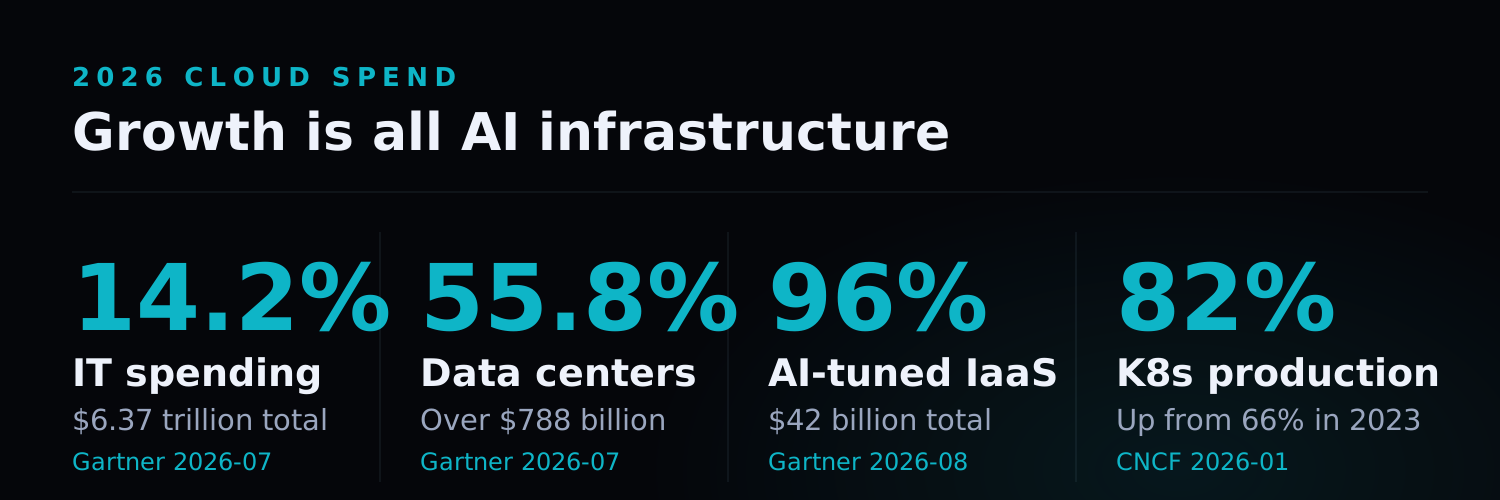
AI has repriced the cloud market in 2026. Here are the sourced numbers, and what they mean for a normal company that is not building foundation models.
Three numbers that set the year
| Metric | 2026 figure | Source |
|---|---|---|
| Worldwide IT spending | $6.37 trillion, up 14.2% | Gartner, Jul 2026 |
| Data centre systems | Over $788 billion, up 55.8% | Same release |
| AI-optimised IaaS | $42 billion, up 96% | Gartner, Aug 2026 |
Almost all of the growth sits in AI infrastructure. That means two things for everyone else: compute is tight and prices drift up, and cloud bills are more volatile than they were three years ago.
Four consequences for ordinary workloads
1. Budget for increases, not for flat pricing
Cloud cost conversations used to be about trimming waste. In 2026 the base price is moving, particularly for GPU instances. Forecast usage growth and unit price separately, or you will not be able to explain an overrun when it happens.
2. In AI projects, inference is the cost centre, not training
Most companies will never train a model, but they will run inference for years. Inference cost scales with call volume, so it rises linearly with adoption. Before you build, estimate monthly calls × cost per call. That number usually matters more than the development fee.
3. Kubernetes is the default, which does not mean you need it
In CNCF’s 2025 annual survey, 82% of container users run Kubernetes in production, up from 66% in 2023, and 98% of surveyed organisations have adopted cloud native technology (CNCF, Jan 2026).
The same survey puts the top adoption barriers at team culture (47%) and lack of training (36%), not the technology. The Kubernetes bill is paid in people, not licences. With fewer than five engineers and a handful of services, a managed platform is usually the cheaper answer.
4. Sovereignty has become a procurement requirement
Gartner expects sovereign cloud IaaS spending to reach $80 billion in 2026 (Gartner, Feb 2026). For anyone operating across borders, data residency has moved from a compliance annex into an architecture decision that drives region choice and failover design.
Three things worth re-checking this quarter
- Cost attribution. Can you say which feature costs the most? Without tagging and allocation, optimisation is guesswork.
- Cost of downtime. What does one hour offline cost you? That number should decide your redundancy spend, not the other way round.
- Who maintains it. Services, prices, and quotas keep changing. An architecture nobody reviews is expensive and brittle within two years.
The takeaway
In 2026 the question is not whether to be in the cloud. It is how usage is forecast, who owns the cost, and who maintains the architecture. The technology choice is the easy part.
If your cloud bill keeps climbing and nobody can explain where it goes, we can start with an architecture and cost review before deciding what to change.