
The useless part of a trends article is the list of technology names with no answer to “so what should I do”. These five have data behind them and change decisions you are making this year.
1. Investment doubled, value has not caught up
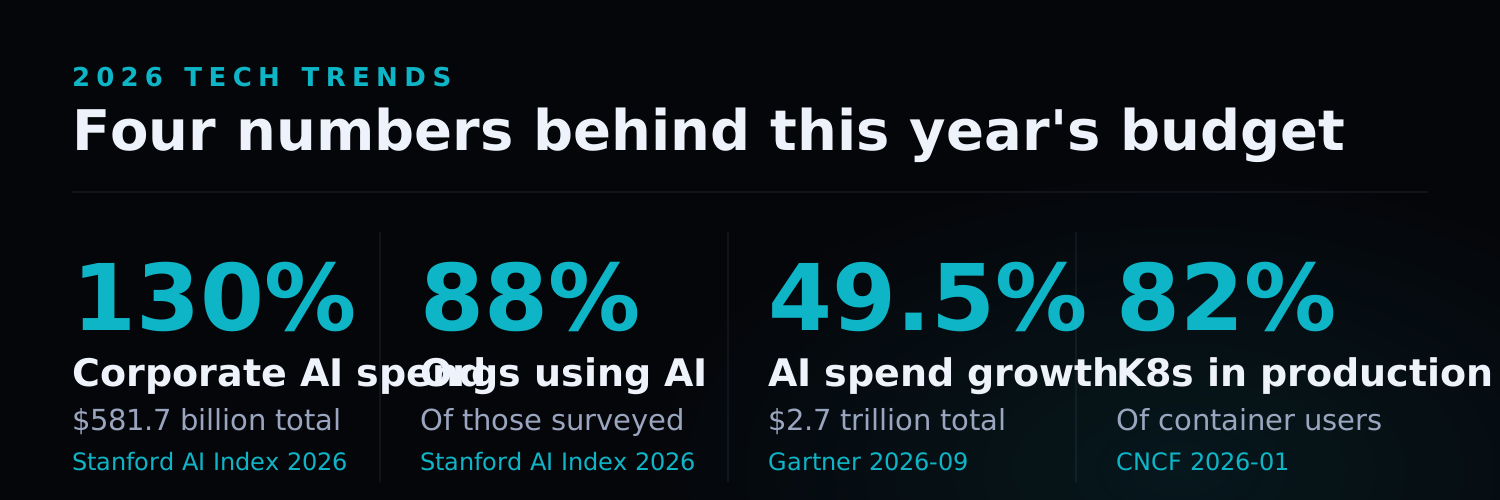
Stanford’s AI Index 2026 reports $581.7 billion in global corporate AI investment in 2025, roughly 130% up year on year. Private investment reached $344.7 billion, with generative AI growing over 200% and taking nearly half of all private funding (Stanford HAI).
The same report puts organisational AI adoption at 88% of surveyed organisations. Adoption is high, but most organisations cannot state what they saved. The difference is not the model. It is whether anyone measured the baseline.
Do this: before any AI project starts, write down the manual process hours and error rate. Without a baseline, the project closes on a feeling.
2. Compute is now the main line in the IT budget
Gartner forecasts $2.7 trillion in worldwide AI spending for 2026, up 49.5% (Gartner, Sep 2026), inside total IT spending of $6.37 trillion, up 14.2%, with data centre systems up 55.8%.
Do this: give AI its own budget line instead of folding it into software or cloud. Mixed in, nobody can tell later where the money went or whether it worked.
3. Kubernetes has become the operating system for AI
From CNCF’s 2025 survey: 82% of container users run Kubernetes in production, and 66% of AI adopters use Kubernetes to scale inference workloads (CNCF, Jan 2026).
Do this: if your AI service is a few inference endpoints, a managed service is enough. The real signals that you need Kubernetes are multiple teams sharing a cluster, custom scheduling, or GPUs that must be split across workloads.
4. The bottleneck moved from technology to the organisation
In the same CNCF survey, the largest barriers are team culture (47%), lack of training (36%), and security concerns (36%). Technical complexity ranks lower.
Do this: put training and handover time in the project plan, not after go-live. Most failed rollouts fail because nobody wanted to own the thing afterwards.
5. Document and workflow automation lands before “AI agents”
The market talks about autonomous agents. What actually reaches production this year, with a return you can calculate, are bounded tasks: document extraction, data capture, drafting, classification, and routing. High volume, clear rules, visible errors. That is exactly where current models are reliable.
Do this: start with one process that has a clear input and output, and keep a person in the approval step. Once accuracy is stable, talk about handing over more of the decision.
Three things worth doing this year
- Baseline one process. Useful whether or not you end up automating it.
- Budget AI separately, so cost and result can be compared.
- Decide who maintains it before choosing the stack. A system nobody owns will break regardless of the technology.
If you want to start with the first one, we can run a workflow review and fill in the baseline table with you before anyone writes code.