
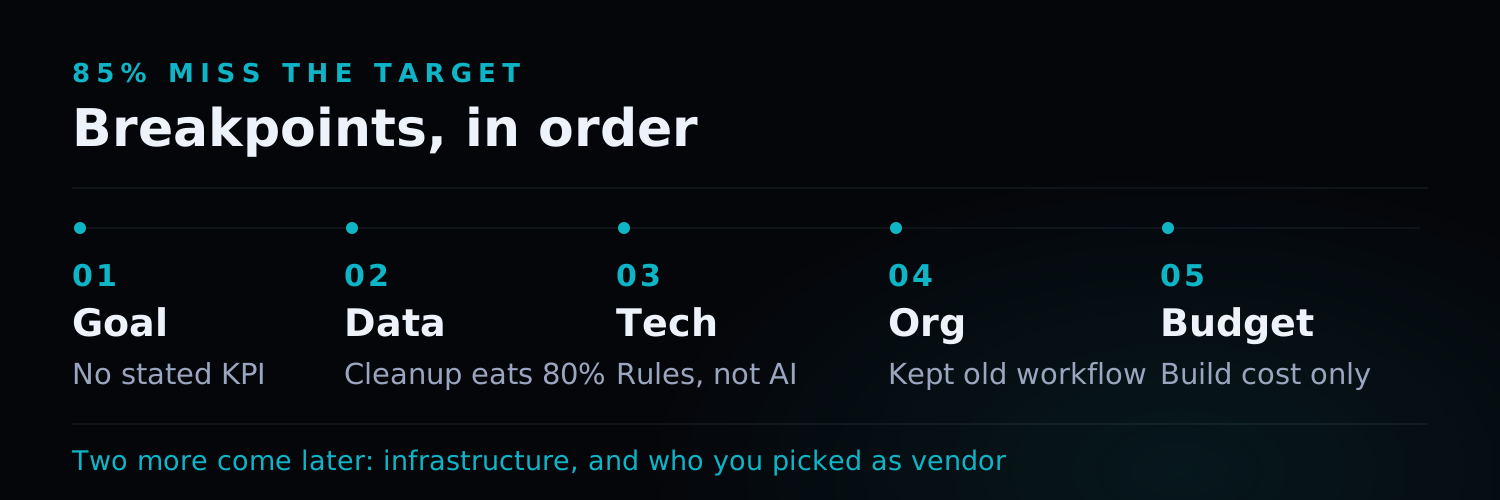
TL;DR: According to Gartner, approximately 85% of enterprise AI projects fail to deliver expected business value. The root causes are rarely technical — they are systemic issues across strategy, data, organization, and management. This article analyzes the seven most common failure reasons, from lack of business objectives to vendor selection mistakes, and provides concrete warning signs and solutions for each, so your enterprise can avoid these costly traps.
Introduction
AI is one of the most transformative technologies of our era. But there is an enormous gap between “adopting AI” and “successfully adopting AI.”
The reality is sobering: according to Gartner’s 2024 research, roughly 85% of enterprise AI projects fail to deliver expected business value (Gartner, 2024). Analysis from the RAND Corporation goes further, estimating that large-scale AI project failure rates reach 80% — significantly higher than the 50% failure rate of traditional IT projects (RAND, 2024).
These numbers are not meant to discourage you. They are a reminder that successful AI adoption requires far more than good technology. It demands clear strategy, a solid foundation, and systematic execution.
Over the course of 12+ years of software development and technology consulting across 300+ enterprise projects, we have observed and participated in enough AI initiatives to identify the patterns that separate success from failure. Below are the seven most common reasons enterprise AI adoption fails, along with actionable solutions for each. If you are planning or executing an AI adoption initiative, this article could save you hundreds of thousands of dollars in trial and error.
For the complete AI adoption framework, we recommend reading this alongside our Complete Enterprise AI Adoption Guide 2025.
Reason 1: Lack of Clear Business Objectives
The absence of well-defined business objectives is the single most common reason enterprise AI projects fail — and according to McKinsey, the biggest barrier to scaling AI beyond pilot projects.
Far too many enterprises launch AI initiatives because “competitors are doing AI” or “leadership wants to do something with AI,” rather than starting from a specific business problem. The result is significant resource investment with no clear definition of what success looks like.
Warning signs:
- The project goal is “use AI to improve efficiency” but no one can specify which efficiency metric will improve
- Success criteria (KPIs) for the AI project cannot be clearly defined
- Business units are indifferent to or disconnected from the AI initiative
Reason 2: Insufficient Data Quality and Governance
Data is the fuel that powers AI. Without high-quality data, even the most sophisticated models cannot produce valuable results. According to IBM research, enterprises lose an average of $12.9 million per year due to poor data quality (IBM, 2024).
Common data problems include:
- Data silos: Data is scattered across departments in disconnected systems
- Poor quality: Missing values, duplicate records, inconsistent formats, labeling errors
- Lack of governance: No data owners, no quality standards, no access controls
- Privacy compliance gaps: Inadequate handling of personal data protection and cross-border data transfer requirements
Warning signs:
- Cross-departmental data integration takes weeks or months
- Data scientists spend more than 80% of their time cleaning data
- No one can provide the exact definition or provenance of a given data field
Reason 3: Chasing Technical Novelty Over Business Value
Technology-driven rather than business-driven AI projects frequently fall into the trap of “using AI for the sake of using AI” — pursuing the latest models and coolest techniques while overlooking the solution that best fits actual business needs.
Typical symptoms:
- Using deep learning to solve a problem that could be handled by a rule engine
- Insisting on building a proprietary large language model when an API integration would be far more cost-effective
- Teams spend months studying the latest research papers but fail to deliver a usable product
- Over-engineering leads to unmanageable system complexity and spiraling maintenance costs
Warning signs:
- The technical team cannot explain the business value of the AI project in a single sentence
- The technical architecture is already overly complex at the PoC stage
- Technical approaches are frequently changed to chase the latest trends
Reason 4: Neglecting Organizational Change Management
AI adoption is not just a technology project — it is an organizational transformation. According to Prosci research, effective change management increases project success rates by a factor of six (Prosci, 2024). Yet most enterprises allocate 90% of resources to technology and only 10% to organizational readiness.
Common problems:
- Employees fear being replaced by AI and develop resistance to the project
- Business units are not involved in defining requirements or testing the AI solution
- Leadership verbally supports AI but is unwilling to adjust organizational structures or workflows
- No AI-related training programs exist, leaving employees unsure how to collaborate with AI systems
Warning signs:
- Employees continue using old workflows after the AI system goes live
- Business teams complain that the AI system is “unusable” or “unreliable”
- Cross-departmental collaboration is difficult and the AI project is viewed as “an IT thing”
Reason 5: Unrealistic Budgets and ROI Expectations
Many enterprises either underinvest or overinvest in AI — and almost universally hold unrealistic expectations about returns. According to an Accenture survey, 75% of enterprise executives admit they underestimated the total cost of their AI projects (Accenture, 2024).
Common budgeting mistakes:
- Accounting only for development costs while ignoring data governance, system integration, training, and maintenance expenses
- Expecting AI projects to generate significant ROI within 3 months
- Underestimating LLM API runtime costs (which can consume 30-50% of budget at scale)
- Failing to budget a buffer for unsuccessful PoCs
Warning signs:
- The budget plan includes only a single line item for “development”
- Leadership expects to “do AI” for $15,000-$30,000
- No phased ROI milestones have been established
Reason 6: Immature Technical Infrastructure
Even with a solid AI strategy and high-quality data, inadequate technical infrastructure will derail AI projects. According to IDC, 42% of AI project delays or failures are caused by infrastructure issues (IDC, 2024).
Common infrastructure gaps:
- Existing IT systems lack APIs, preventing integration with AI modules
- Insufficient compute resources lead to poor model training and inference performance
- No MLOps processes — taking months to move models from development to production
- Excessive legacy systems with inconsistent data formats, driving integration costs through the roof
Warning signs:
- Data scientists must manually deploy models to production
- No monitoring in place after model deployment — performance degradation goes undetected
- A simple model update takes more than two weeks
Reason 7: Vendor Selection Mistakes
Choosing the wrong AI vendor or implementation partner is an expensive mistake. In the AI space, vendor capability varies enormously — from junior teams that can only apply off-the-shelf open-source models to senior consultants who can design complete enterprise-grade AI architectures. The difference can determine whether a project succeeds or fails.
Common selection mistakes:
- Choosing the cheapest vendor while ignoring capability and experience
- Being swayed by over-polished demos that mask real-world production challenges
- Selecting a team strong in academic research but lacking engineering and deployment experience
- Choosing a vendor with no understanding of your industry
Warning signs:
- The vendor cannot provide successful case studies in your industry
- The technical solution is overly dependent on a single tool or platform
- The vendor team constantly uses technical jargon but cannot articulate business value
- The contract lacks clearly defined deliverables and acceptance criteria
Failure Reasons Summary Table
| Failure Reason | Warning Signs | Solution |
|---|---|---|
| Lack of clear business objectives | Cannot define specific KPIs; business units are disengaged | Start from business pain points; set quantifiable targets |
| Insufficient data quality and governance | Data integration takes months; data definitions are unclear | Build a data governance framework before launching AI projects |
| Chasing technical novelty | Overly complex architecture; frequent approach changes | Be pragmatic; start with simplest viable solution |
| Neglecting organizational change | Employees bypass AI systems; cross-team collaboration is weak | Deep business involvement + training + AI champion programs |
| Unrealistic budgets and ROI expectations | Only development costs budgeted; 3-month ROI expected | Total lifecycle costing + phased ROI milestones |
| Immature technical infrastructure | Manual model deployment; no monitoring in place | Cloud-first + MLOps + incremental modernization |
| Vendor selection mistakes | No industry case studies; no clear deliverables | Multi-dimensional evaluation: industry + depth + methodology |
AI Adoption Readiness Self-Assessment Checklist
Before launching an AI project, use this checklist to quickly assess whether your organization is ready. Answer “yes” or “no” to each item — the more “no” answers, the higher the risk.
Strategy
- We have identified specific business problems, not just “we want to use AI”
- We have defined quantifiable success metrics (KPIs)
- Executive leadership genuinely understands and supports the AI initiative (beyond lip service)
- Our AI strategy aligns with our overall digital transformation roadmap
Data
- Relevant data for the target use case is accessible and of acceptable quality
- A data governance framework exists or is being established
- Data privacy and compliance requirements have been assessed and addressed
- Cross-departmental data integration pathways are clearly defined
Technology
- Existing IT systems have APIs or other integration interfaces
- MLOps processes have been planned or established
- Sufficient compute resources are available (or cloud options have been evaluated)
- Post-deployment model monitoring and maintenance needs have been considered
Organization
- A cross-functional AI project team has been assembled or planned
- Employee training and change management plans are in place
- Business units are deeply involved in requirements definition
- Adequate budget and time buffers have been reserved
Frequently Asked Questions
How should we restart after an AI project fails?
Start with an honest post-mortem analysis of the root causes. Common steps include: (1) Redefine business objectives to ensure AI addresses a genuine business pain point, (2) Narrow the scope — restart with the simplest valuable use case, (3) Invest in fixing data and infrastructure shortcomings, (4) Supplement or replace team members and partners as needed, (5) Set more conservative but quantifiable success criteria. Failure is not fatal — failing to learn from failure is.
How can small and mid-sized businesses reduce AI adoption failure risk with limited resources?
SMBs have the advantage of agility and fast decision-making. Recommended strategies: (1) Do not build models from scratch — prioritize cloud AI services and APIs (e.g., GPT-4 API, Claude API) to dramatically lower technical barriers and costs, (2) Start with a single high-value use case (such as customer service automation or document processing) rather than pursuing enterprise-wide AI, (3) Choose partners with SMB experience rather than vendors who only serve large enterprises, (4) When budget is tight, invest 3-4 weeks in a feasibility assessment before committing to full implementation.
How do we decide whether to continue or cut losses on an AI project?
Set three key checkpoints: PoC completion (typically 8-12 weeks), 3 months into pilot, and 6 months after production launch. At each checkpoint, evaluate: (1) Whether phase-specific KPIs have been met, (2) Whether the technical approach remains viable, (3) Whether business stakeholders still see value in the solution, (4) Whether projected ROI for continued investment is reasonable. If two consecutive checkpoints miss targets, seriously consider stopping or fundamentally redirecting the project.
Given such high failure rates, should we wait for AI technology to mature before adopting?
Waiting is a valid strategy, but it carries opportunity cost. The issue is not whether AI technology is mature (in 2025, it decidedly is), but whether your organization is ready to use it effectively. A balanced approach: start AI strategy planning and data governance now (you will need these regardless of when you adopt), while running small-scale experiments in low-risk scenarios. You do not need to make a large investment, but doing nothing means your competitors will build capabilities while you stand still.
Conclusion
AI adoption failure is not a technology problem — it is a systemic management problem. From strategy gaps to vendor selection mistakes, these seven reasons account for nearly every failure pattern we have encountered in practice.
The good news is that every one of these failure reasons is preventable. The keys are:
- Strategy first — Start from business objectives, not technology trends
- Foundation matters — Invest in data governance and technical infrastructure
- People-centered thinking — Prioritize organizational change management so humans and AI collaborate effectively
- Pragmatic incrementalism — Start small, validate fast, then scale
- The right partner — Choose one who understands your business and has real-world delivery experience
At Nxtcloud, we do not just deliver technology solutions — we provide end-to-end support from strategic planning through production deployment. With 12+ years and 300+ enterprise projects behind us, we know that avoiding pitfalls is just as important as finding shortcuts.
Concerned that your AI project might be heading off course? Schedule a free consultation and let our expert team help you diagnose potential risks, develop prevention strategies, and chart the most reliable path to AI adoption. Or simply contact us to discuss your specific challenges.
Related Articles
- The Complete Enterprise AI Adoption Guide 2025 — The full framework from strategy to scaled deployment
- Agentic AI Explained: How Enterprises Build AI-Powered Workflow Automation — Understand next-generation AI applications for the enterprise
- Digital Transformation ROI Framework — How to scientifically measure digital transformation and AI investment returns